Roger Penrose remembers his most beautiful thought

The following was transcribed from this YouTube video: We need to 'gravitise' quantum mechanics, not quantise gravity | Roger Penrose | Full Interview

Penrose is 93 and in an amiable mood in this interview, so he goes into minor non-mathematical tangents from time to time. I've edited the following for clarity so that just the mathematical structure comes through:

Engelbert explained two things to me which were extremely important to me. One was that Maxwell's equations, the equations of electricity, magnetism and light, are conformally invariant, which means you don't need to scale -- size doesn't come into it. On the big scale and the small scale they're exactly the same. They're insensitive to change of scale. So I find that very beautiful. The other thing he told me was that in quantum field theory, the most important thing is the splitting of field amplitudes into positive and negative frequencies. I can't really go about being a little more technical what that means, but what it usually means to people is you take what's called the Fourier decomposition and then you take the positive part each time. So you've got different frequencies involved and you take each frequency and you split it into the positive/negative frequencies. And you do that all the way along. I didn't like that much because that splitting is not conformally invariant. And if you want to do it for Maxwell's theory, it would be much nicer to have a way of saying it which didn't involve all this Fourier decomposition. 

So I thought, well, there is a way of doing that. You just think -- I should explain this all involves complex numbers -- quantum mechanics is absolutely bound up with complex numbers, which I may say is one of the things which attracted me to the subject. It's an extremely beautiful theory in mathematics. There are various things which -- to understand them properly -- you think of them in this complex number context. There are certain things which work so much better when you do that. And this is one example.

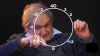
Penrose drawing a projectively extended real number line in the air

You think of the real numbers, together with infinity. So I'm conformally -- infinity is -- just like another number connects the positive ones and the negatives like a circle. You see: zero, one, two, three, four, when it gets closer and closer, a little more... infinity! And then minus infinity is the same point... minus two, minus one, zero. Beautiful circle, you see. Think of that as the equator of a sphere. You have a function on that equator -- that's the real numbers -- and you look at the parts of that function which extends into the positive hemisphere and the part which extends into the negative hemisphere. One is the positive frequency and the other is a negative frequency. I thought: "That's much more beautiful," the idea that you could talk about this fundamental feature of quantum theory in terms of this geometry of the sphere. The real numbers -- together with infinity -- cut it in half.

So what I was thinking: "I really don't want to do this for one dimensional time or something like that. I want to do it globally for the whole of space time." What a silly idea, but that's what I thought. There must be a way of doing it for the whole of space time. There was a thing that I knew about called the forward tube, which is what happens in a complexified space time, but then you get eight dimensions and... nothing divides anything in half. It doesn't work at all. So I knew about it, but there was no help.

But you see, I knew of what Ivor had told me, and he described to me this class of solutions of Maxwell's equations that were based on these classes of light rays. When I say light ray, I'm thinking of the trajectory of a photon, if you like. So it moves along, but in the history of the space time, it's a line. So it's a space time line. So when I say light ray, that's what I mean. I call it Robinson congruence.

You take the light ray that all the other light rays meet. See, there all the other ones meet it and you construct your solution of Maxwell's equation on the basis of those lines. This is a very beautiful solution. But what you can also do is displace this light ray into the complex and the other ones are still there. They're still the ones that meet it. They sort of meet it -- in an imaginary way -- but they do still. And you get the same -- congruence as it's called -- but it twists around and it doesn't have any singularities. It doesn't meet the line. You see, where all the lines meet, it's a sort of singular place. But if you displace the line into the complex, they don't. They twist around in this amazing way. And I had sort of understood that configuration already.

Clifford parallelIt's as if from a three-dimensional terms, you can think of it in terms of what are called Clifford parallels. There's a certain construction done by this British mathematician... he discovered this amazing construction which is... you have to think of a sphere in four dimensions, so it's a three-dimensional surface in four dimensions. And in that surface, you have this family of circles, all of them which link each other in this amazing twisty way. And I sort of knew that I was describing that -- that the way they twist is the Clifford parallels.

And so I thought to myself, how many dimensions did that space have? How many of these twisting families are there compared with the number of light rays are there? And I thought, gosh, it's just six. Whereas the number of light rays, how many dimensions is the space of light rays, how many parameters do you need to describe the light rays? It's five. How do you ascribe the Robinson congruence? Six. One more. Why is that exciting to me? Because I'm looking for a space where the real things that you talk about -- that's the light rays -- I should be thinking not points but light rays. That was the key. Think of light rays. Don't think of points.

The points of space time are four dimensional, and if you complexify, it's eight dimensional. It's no use to me. But I think of the light rays and then I see them in the subtle Robinson way, then I only get six dimensions. So my space is split into two halves, the ones which twist right handed, the ones which twist left handed, and the ones which don't twist, which are the light rays. And that was my key thought.


How to connect to SQL Server on Amazon with sqlcmd and import data from a SQL file

I found this information from MS to be insufficient, and pieced together the correct way to import data into SQL Server from a SQL file into an Amazon database using a non-standard port: sqlcmd -S tcp:mydata.c960gorblahblah.us-west-2.rds.amazonaws.com,1337 -U username -P p@ssW@rd~ -d mydatabasename  […]

Continue reading

A golden crown with a band of rubies around the base

Just awakened from a wonderful dream, like an intricate adventure story where Indiana Jones might appear at any moment. I was somewhere in Central America, and I had just accidentally found an ancient relic, a golden crown with a beautiful band of rubies near the base. Before that scene, as I write  […]

Continue reading

How to properly reset the VBoxClient clipboard (copy-paste from guest to host) on Devuan Linux and probably Debian too

There is an elusive bug in the VirtualBox client software, which on rare occasions causes the clipboard to stop working. I've seen the issue with both Windows and Linux guests, and I've developed workarounds by writing tiny scripts that reset the client software. However, my standard Devuan client  […]

Continue reading

Yearning for silence and talking to God about it

Today is my birthday and I am yearning for silence of a rare kind. I've been yearning for silence for years, as may be clear to one reading many of my preceding weblog articles here over the past five years or so. Today, as the sun rises and I am contemplating my life in the annual "it's your  […]

Continue reading

On the new fallacy of hasty bifurcation

The image to the right gives an example of two laws, or two principles. The "Law of Excluded Middle" and the "Principle of Bivalence." They are presented as being distinct from each other, but in fact, they are two sides of the same hair being split down the middle, and they're  […]

Continue reading

Get filename and path after a file is uploaded using Laravel Filament afterStateUpdated

It should not be so difficult to find something so trivial. So in hopes of helping someone else find the answer more quickly than the several days it took me, here is a conversation I had recently in a Discord chat for Laravel Filament. Scroll to the very end for the TL;DR one-liner answer.  […]

Continue reading

How to become a saviour of the world

In a dream from which I awakened as my alarm went off at 5 this morning, I was on a comfortable tour bus with friends. The bus stopped and I saw that there was a large crowd of people gathered around, like a state fair or something. I was contemplating whether to stay on the bus or get out for  […]

Continue reading

How to run a VirtualBox Linux nested inside a VirtualBox Windows running on Linux so you can ShareX a Linux desktop

Yes, you could use Wine, but for diehards, here's this. I used Linux Mint and Windows Ameliorated, but the same basic steps should work for other flavors. You're going to want a good amount of RAM, disk space, and a fast CPU. I used 12Gb RAM for the outer VirtualBox and 8Gb RAM for the innermost,  […]

Continue reading

How to fix security issue in Dradis where Ruby Rails Mini Profiler "Rack Environment" is enabled and visible when using pp=env

I'm not familiar with Ruby, Rails, Puma, or anything else in the Ruby environment, although I'm well familiar with other programming environments which are similar. Still, it took me longer to install Dradis than it should have, and I finally gave up on the Docker version entirely. I had to cobble  […]

Continue reading

'The reward of wisdom comes in silence,' saith the fool, and then he spoke no more

To listen the gift of listening, one must first listen What a way to begin the year. This morning I awakened in the dark before the alarm went off, which is always a good way to start a day. Quiet thoughts ambled through my mind for a while. At the conclusion of a chain of thoughts which have now  […]

Continue reading

Eramba System Health Check fails immediately after installation due to cron error but really it's an .env file issue

System Health Warning: This installation of eramba has a few issues in order to work properly. Check on the settings page under health monitor what could be the issues or click here

The .env file for an eramba installation cannot have #comments. If you have comments, it will silently fail, and you'll see this error message: "System Health Warning: This installation of eramba has a few issues in order to work properly. Check on the settings page under health monitor what  […]

Continue reading

How to open files in vscodium using link in a browser to vscode: add a registry key

To open up a file within a browser having a vscode://file/ URL like this: vscode://file/C:\xampp\htdocs\mycoolapp\app\Models\Membership.php So it looks like this:   Then save the following as a registry file named vscode.reg: Windows Registry Editor Version 5.00  […]

Continue reading

How to fix the multiple monitor resize after lock screen issue in Ubuntu Linux (and Mint, PopOS, etc) with GNOME

TL;DR Quick Fix is at the END for people who want to get to the deets w/o prolegomenon. I put as many keywords as I could into the headline so this post is easy for others to find. Although I'm not a gamer, I have a super duper Lenovo Legion gamer laptop with all kinds of nVidia power for my daily  […]

Continue reading

Euclid's clever solution to the problems of the void and the infinitesimal

Euclid's Definition 1 Now it's time to unravel something even more fundamental than the 5th postulate: the 1st definition. We normally think of a geometrical point as being smaller than anything, because of where Euclid placed it in the hierarchy of geometry. Building up from simple to more complex,  […]

Continue reading

A way of understanding true trinary logic which includes the continuum and reveals the importance of the word AND

Introducing true trinary Trinary logic is introduced at Wikipedia like this: In logic, a three-valued logic (also trinary logic, trivalent, ternary, or trilean, sometimes abbreviated 3VL) is any of several many-valued logic systems in which there are three truth values indicating true, false, and  […]

Continue reading

An intriguing argument that one plus one is equal to three

No, one times one does not equal two. But here is an intriguing argument that one plus one is equal to three. It sounds absurd, so let's start small and carefully establish the logical elements which comprise this argument. Each element will be seen to be logically sound in themselves. Then we'll  […]

Continue reading

Page top